
In case you missed it, Senate Minority Leader Rob Ortt discussed Senate Republicans’ priorities for next year in a video and in a conversation with the Buffalo News:
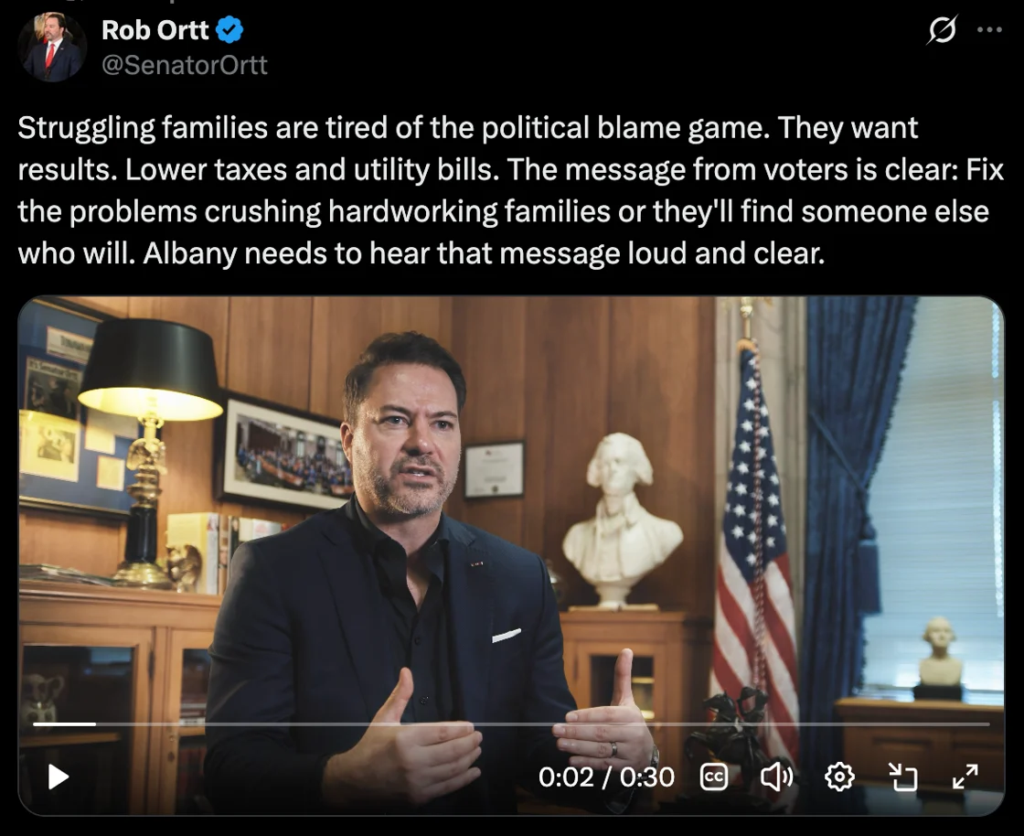
Ortt identifies top priorities after being re-elected to lead Senate Republicans
Robert Gavin
The State Legislature is more dominated by Democrats than ever before.
But that won’t stop one of the most influential Republicans from pushing his agenda.
Newly re-elected Senate Minority Leader Robert Ortt said his priorities for 2027 include radiation cleanups in Western New York, addressing the high cost of utility bills and advocating for his party and the millions of New Yorkers who voted for them.
The North Tonawanda Republican was unanimously re-elected Tuesday to lead the state’s Senate Republican conference in a vote by fellow senators. Ortt, a former mayor of North Tonawanda elected to the Senate in 2014, has led the conference since June 2020.
On Election Night, Democrats won six seats to increase their majority, now 41 to 22, to 47 to 16 in January. All four Senate Republicans representing Western New York – Ortt and Sens. Patrick Gallivan, R-Elma; George Borrello, R-Sunset Bay; and Thomas O’Mara, R-Big Flats, whose district includes eastern Allegany County – were re-elected.
Ortt is now the sole legislative leader from upstate New York. Democratic Assembly Speaker Carl Heastie is based in the Bronx, Senate Majority Leader Andrea Stewart-Cousins is from Yonkers and Assembly Minority Leader Edward Ra, a Republican, is from Franklin Square on Long Island.
“I do believe it’s important that regionally, there is an upstate leader, there is an upstate legislative leader that understands a lot of these upstate issues whether you’re a Democrat or a Republican or no party. I like to think that I speak for those voters as much as I can,” Ortt said in an interview with The Buffalo News in his office in the State Capitol. “That will continue as long as Rob Ortt is in the New York State Senate.”
Ortt said there will be more work to spread out among fewer Republican senators. Every one of those senators, he said, will need to sit on multiple legislative committees. He said Republicans need to focus on their messaging to New Yorkers he said may feel left out by what he expects will be a very left wing agenda from the Senate majority.
“For me, as a leader, you never want to leave your organization in a worse spot than you found it, or in a tough spot,” Ortt said Tuesday. “And I think right now is the time when you’re going to find out who the leaders in our party are because they’re going to stand and fight and the people who want to quit or leave, I guess now is as good a time as any if you’re not up for it. That was the message, certainly, to the members who are coming back or the new members.”
Ortt, whose 62nd Senate District includes all of Niagara and Orleans counties and part of Monroe County, said his top local priority is passing a law to allow radioactive waste to be considered hazardous waste so that funds from the state’s Superfund program, which pays for environmental cleanups, can be used for radiation-contaminated areas in Niagara and Erie counties.
Five months ago, the Environmental Protection Agency started investigating properties for elevated radiation levels. They have scanned more than 1,100 properties and found 40 with elevated radiation levels requiring further EPA review. The state’s Superfund program does not presently allow spending to on radioactive contamination, which is typically handled by the federal government, Ortt noted.
“I think we can make amendments there,” Ortt said, “and I’ve made a commitment that I would push those changes to those folks.”
Addressing the high cost of utility bills will be a top focus statewide, Ortt said. The state budget enacted in May included energy rebates to consumers of up to $200, which Ortt said did not address the greater issue. He said the state can lower taxes and surcharges in utility bills that are collected and passed onto consumers. He questioned why Pennsylvania has similar utilities to New York, but provides energy at costs far lower than New York does.
“Why is that?” Ortt asked. “The only difference are the laws coming out of Pennsylvania and New York.”
In state budget negotiations earlier this year, Heastie and Stewart-Cousins advanced one-house proposals to increase taxes on the rich. Gov. Kathy Hochul kept them out of the budget. New York City Mayor Zohran Mamdani recently called for a tax on the rich to pay for the state’s plans to increase free childcare through prekindergarten programs. Hochul did not rule it out.
Ortt said he is not concerned that billionaires will leave New York, but that higher taxes will affect middle-income New Yorkers and force them to leave the state.
“I absolutely expect that they will increase taxes in the final budget,” Ortt said. “It’s (Hochul) and the Legislature. We know the Legislature would have raised taxes last year and probably every year. So the only person stopping that is (Hochul). The minute she says it’s not a ‘No,’ well, that means some new tax is coming. Some increase in taxes is coming. That’s how I see that.”
One of the more polarizing issues in New York is the future of data centers, which power artificial intelligence. As AI use increases, the need for data centers comes with it, but polls show the facilities are not popular with communities. Hochul signed a one-year moratorium last summer on the state permitting of new data centers, citing concerns over their impact on communities, need for water and energy and the noise they make. The governor did not oppose data centers.
Ortt said the state needs to find a way to have data centers and regulate them.
“It is not a mutually exclusive sort of discussion,” Ortt said.